
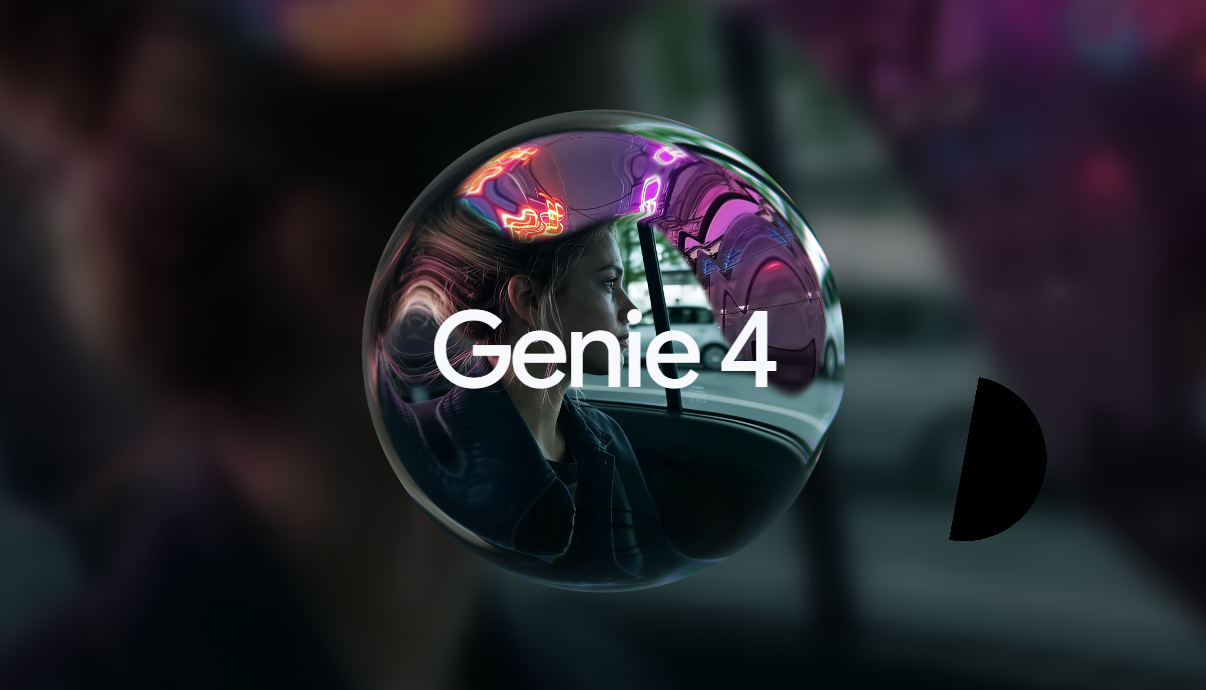
Google DeepMind introduced Genie 4 on October 27, 2026, presenting a new world model designed to create realistic and interactive environments in real time. The research preview brings together visual generation, natural-language control, physical interactions, and native audio.
Unlike conventional image or video generation tools that primarily produce fixed outputs, Genie 4 is designed to create environments that users can explore and modify while the simulation is running. This could open up new possibilities for game development, filmmaking, robotics research, and other creative workflows.
What Is Google Genie 4?
Genie 4 is a world model developed by Google DeepMind. Its purpose is to simulate environments and how they change in response to actions.
Users can start with an initial scene and guide what happens next. For example, they can ask the system to change the weather, move the camera, or introduce new characters. The model then adapts the environment while attempting to maintain continuity.
Google says Genie 4 builds on capabilities from its Gemini model family. Gemini Omni helps ground simulations in real-world appearance and behavior, while other Gemini models contribute reasoning and scene continuity.
This makes Genie 4 different from a traditional text-to-image generator. Instead of creating one finished picture, it aims to generate an environment that can continue responding to user input.
Key Features of Genie 4
Real-Time Scene Control
One of Genie 4's main capabilities is the ability to modify a simulation through natural-language instructions.
Users can make changes while an environment is active, including adjusting camera movement, changing weather conditions, or adding objects and characters. This approach could make early-stage visual experimentation more accessible to creators who do not have extensive 3D development experience.
More Realistic Physics and Character Movement
Google DeepMind highlights improvements in physical interactions and human movement.
The model is designed to simulate events such as collisions and aerodynamic behavior, while characters can move and respond to their surroundings. These capabilities are important for environments that need to feel interactive rather than simply look realistic.
However, realistic simulation remains a difficult technical challenge, and the research preview is not a replacement for professional physics engines or production-ready 3D software.
Native Audio Generation
Genie 4 also introduces native audio generation.
Simulated environments can include ambient sounds, music, and interactive dialogue. For example, a beach environment may include waves and wind, while characters can respond to events through generated speech.
Generating sound alongside the visual environment could make interactive scenes more immersive and reduce the need to create every audio element separately.
Gemini-Powered Reasoning
Google also describes how Gemini models can help Genie 4 manage more complex events.
The reasoning system can interpret goals, break them into steps, observe the simulation, and adjust its plan as the environment changes. This combination could be useful when building scenarios that involve multiple actions rather than a single visual transformation.
How Genie 4 Could Be Used
The technology has potential applications across several industries.
- Game development: Developers could test environments, characters, and gameplay concepts before building a complete game.
- Filmmaking: Creative teams could experiment with camera angles, lighting, and scene direction during early production.
- Education: Interactive environments could help explain complex situations through visual simulations.
- Robotics research: Simulated environments may provide flexible scenarios for testing how robots and agents respond to different conditions.
- Journalism and visualization: Creators could explore ways to represent historical or environmental events through interactive scenes.
These are potential use cases being explored around the technology, not a guarantee that Genie 4 is already suitable for every professional production workflow.
Is Google Genie 4 Available Now?
Genie 4 is not yet generally available to everyone.
Google DeepMind began rolling it out as a research preview to a limited group of trusted testers. The company says it is expected to become available to Google AI Ultra subscribers through Project Genie, as well as selected early-access partners using the Gemini API and Google AI Studio.
Access and availability may change as testing continues.
Current Limitations of Genie 4
Despite its improvements, Genie 4 remains an experimental technology.
Google notes that environments can experience visual drift during longer sessions. Objects and details may change unexpectedly, especially after multiple complex edits or extended navigation.
Other areas still under development include complex physical interactions, audio accuracy, readable text, spatial precision, and long-term consistency.
These limitations matter because an interactive world model needs to maintain more than visual quality. It must also preserve the relationships between objects, characters, and events over time.
Why Genie 4 Matters for the Future of AI Creation
Genie 4 represents a broader shift from generating individual media files toward creating interactive experiences.
Image and video generators help users produce visual content, while world models aim to simulate how an environment behaves when something changes. Combining these approaches could eventually support more flexible creative workflows.
For developers and creators, the important development is not simply that AI can generate realistic scenes. It is that users may be able to enter those scenes, interact with them, and guide what happens next.
Genie 4 is still in an early research stage, but its approach offers an interesting look at where interactive generative technology could go next.
Official source: Google DeepMind - Genie 4: A New Generation of World Simulation